
For much of the last century, the prevailing principal of displaying art, particularly with contemporary art, has been fairly simple:
Give every artwork space to breathe. One painting. One wall. Plenty of empty space surrounding it.
There is a certain beauty in restraint, but recently a much older tradition has begun to make its return — the salon-style hang.
From Buckingham Palace to Contemporary Homes: Why the Salon Wall is Returning
The newly reimagined Picture Gallery at Buckingham Palace offers a perfect example. Drawing inspiration from historic presentations of the Royal Collection, the gallery has returned to a denser arrangement where paintings are displayed together in a carefully considered composition rather than as isolated objects. The result is not clutter; it is conversation. Masterpieces from different periods and traditions are allowed to interact, creating a visual experience that feels layered, personal, and alive.

The salon hang originated in 18th-century Europe, when galleries displayed paintings from floor to ceiling as a reflection of abundance, curiosity, and intellectual discovery. Visitors were encouraged to explore — to move through the space, discovering relationships between works.
Why the Salon-Style Fell Out of Favor
By the early-to-mid 20th century, however, the salon-style of hanging art began to fall out of favor as modernist ideas reshaped the way art was presented. The emphasis shifted towards simplicity, negative space, and allowing each individual artwork to stand alone without visual competition. The minimalist approach became the dominant language of galleries and museums, influencing how many collectors thought about displaying art in their own homes.
While this cleaner presentation can create a sense of elegance, it also changed the relationship between the viewer and the collection. Instead of experiencing a room as a story made up of many voices, art became increasingly viewed as individual statements separated from one another.
The Salon-Style Wall Creates a Conversation
Having been underutilized for the past one-hundred years, the salon-style approach feels surprisingly fresh today.
A thoughtfully curated salon wall adds something that a single large artwork often cannot: a sense of history. It suggests that the collection has been built over time, that each piece has a story, and that the owner is someone who lives with art rather than simply placed it in a room.
The key word though is curated.
Curating a Salon-Style Wall: The Art is in the Arrangement
A successful salon wall is not about filling every available inch. It requires balance, rhythm, and an understanding of how colors, textures, frames, and compositions interact. The relationship between the works becomes as important as the individual pieces themselves.
Timeless Materials: The Beauty of Unlacquered Brass Hardware
One detail that can elevate this presentation even further is the use of timeless materials. An unlacquered brass hanging system, for example, brings warmth and craftsmanship to the installation. Unlike polished metals that are designed to remain unchanged, unlacquered brass develops a natural patina over time, gaining character and depth. Like a fine leather chair or a lived-in pair of selvedge denim jeans, it becomes more beautiful through time and use.
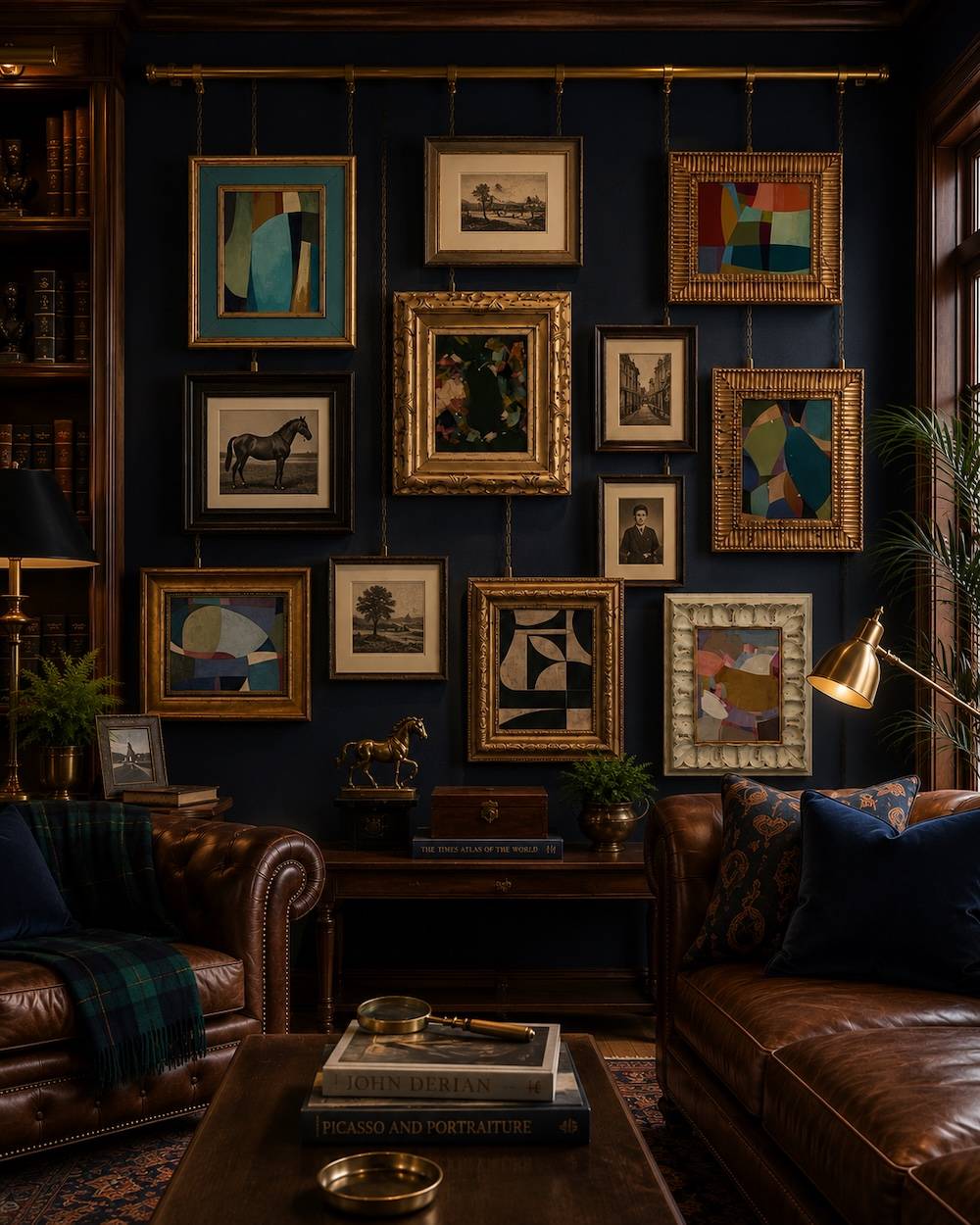
This combination of traditional presentation and contemporary artwork creates an especially compelling tension.
When Contemporary Art Meets Historic Tradition
The abstract works of artist Suzanne Nicoll demonstrate why the salon style is not limited to Old Masters or traditional collections. Her paintings have a contemporary sensibility — layered surfaces, expressive compositions, and a sophisticated approach to color and pattern — yet they possess the depth and texture that allows them to exist beautifully within historic frames.

Placed together in a salon arrangement, her works create a dialogue between tradition and modernity. The centuries-old idea of collecting and displaying art finds new life through a contemporary voice.
Perhaps that is the greatest appeal of the salon wall, it reminds us that art does not exist in isolation.
Why Art Collections Should Tell a Story
The most interesting collections are not static. They evolve, they tell stories, and they reveal something about the person who assembled them. A room filled with thoughtfully chosen artwork becomes more than a decorated space — it becomes a reflection of curiosity, experience, and personal history.
The salon wall is not a return to the past.
It is a reminder that some traditions never truly go out of style.